The Art of Ottoman Script: History, Secrets, and Structure of the Empire's Alphabet
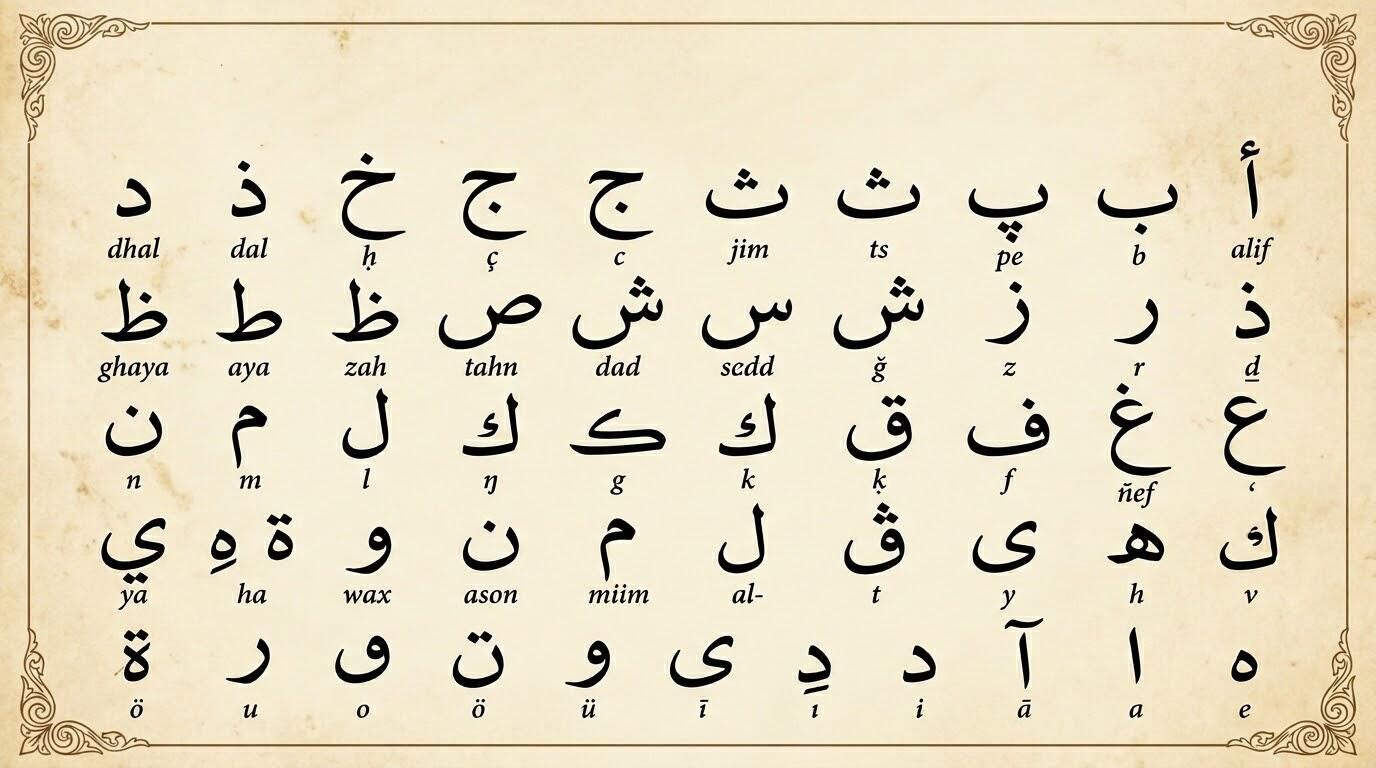
The Ottoman Turkish language (Lisan-ı Osmani) is a fascinating linguistic phenomenon combining a Turkic grammatical core, a rich vocabulary layer of Arabic and Persian, and elegant Arabic script. For over six centuries—until the major language reform spearheaded by Mustafa Kemal Atatürk in 1928—this script served as the official written standard of the Ottoman Empire. The primary instrument of this written tradition was the Ottoman alphabet (Osmanlı elifbası), an adapted variant of the Perso-Arabic script.
Structure and Features of Ottoman Script
The Ottoman alphabet contained 31 to 33 letters (the exact number varied slightly across historical eras). Because classical Arabic script originally evolved to fit a Semitic language, Ottoman calligraphers and scholars borrowed modified letters from the Persian alphabet to express distinct Turkic sounds:
P (پ): Absent in standard Arabic.
Ch (چ): Used to convey the soft "ch" sound.
Zh (ژ): Rare, appearing mostly in borrowed Persian and European words.
G / N (گ / ڭ): The special letter sagır nun or "Ottoman N" (ڭ) represented a nasal sound [ŋ], a staple of Turkic languages.
Writing ran from right to left, and most letters altered their visual shape depending on their position within a word (initial, medial, final, or isolated).
The Linguistic Paradox: Why Was Ottoman Difficult to Read?
The Ottoman script functioned as an abjad (a consonantal writing system), meaning it primarily rendered consonants. Vowels were either left out entirely or indicated using multi-purpose letters like alif, waw, and ya.
This created significant friction with Turkic speech, where vowels play a central role and follow strict vowel harmony rules. While spoken Ottoman featured 8 to 9 distinct vowel sounds, the written text had only 3 to 4 symbols to represent them. Consequently, a single written word could often be read in multiple ways depending on context, requiring a high degree of erudition from the reader.
The Art of Calligraphy (Hat)
The Ottoman alphabet was far more than a practical system for recording information—it was a celebrated high art form. Ottoman masters brought Arabic calligraphy to peak perfection, developing several distinct scripts:
Naskh (Nesh): A clear, legible script used primarily for copying books and administrative texts.
Thuluth (Sülüs): A monumental, highly ornamental script used on mosques and architectural landmarks.
Riqa (Rik’a): A swift, simplified cursive style used in 19th-century daily business and administrative correspondence.
Diwani (Divanı): An intricately stylized, ornate script reserved exclusively for the Imperial Council (Divan) to protect official decrees from forgery.
An Era's Symbol and Its Replacement
By the early 20th century, literacy rates across the Ottoman Empire hovered around 10–15%, a challenge scholars often attributed to the complexity of the writing system. Mastering the script demanded years of study, covering not only the letters themselves but also intricate Arabic and Persian grammatical rules.
In 1928, as part of sweeping modernization reforms in the new Republic of Turkey, the nation transitioned to a Latin-based Turkish alphabet (Harf Devrimi). The Ottoman script transitioned into history, cementing its role as a vital piece of world cultural heritage.
Today, the Ottoman script continues to captivate historians, linguists, archivists, and calligraphy enthusiasts worldwide. Mastering it unlocks millions of unique historical documents, royal firmans, poetry collections, and diplomatic records preserved in the archives of Istanbul and Ankara.